
▶ 英語版は下に掲載しています / English version below
国際ゾル-ゲル会議(International Sol-Gel Conference)は、International Sol-Gel Society(ISGS)が主催し、2年に1度開催される国際会議である。ゾル-ゲル法をはじめとするソフトケミストリー(液相からの低温合成手法)によって作製される無機材料および有機-無機ハイブリッド材料を対象とし、前駆体の化学や反応機構といった基礎から、粒子・薄膜・多孔体などの構造制御、さらに光学、エネルギー、環境、医療、エレクトロニクス分野への応用と産業利用までを幅広く扱う。1981年にイタリア・パドヴァで開催された国際ワークショップを起源とし、本分野で最も歴史と権威のある会議の一つとして位置づけられており、セラミックス科学、無機化学、材料工学の研究者が一堂に会する場となっている。
第23回となる今回(Sol-Gel 2026)は、ポルトガルの首都リスボンにあるInstituto Superior Técnico(リスボン大学)アラメダキャンパス内のIST Congress Centreにおいて、2026年8月31日から9月4日までの5日間にわたり開催された。会議では、①ゾル-ゲルプロセスの化学、②ハイブリッド・複合材料、③ナノ材料の設計、④機能性コーティング・薄膜、⑤光学・フォトニクス・オプトエレクトロニクス応用、⑥触媒・センサー応用などのテーマが設けられ、プレナリー講演、招待講演、一般口頭発表、ポスター発表が複数の会場で並行して行われた。世界39か国から、大学・研究機関の研究者、企業関係者、若手研究者など300名を超える参加者が集まった。会期中には、ISGSの各賞の授賞式のほか、バンケット等も行われ、研究発表の場以外でも参加者同士が交流する機会が多く設けられていた。
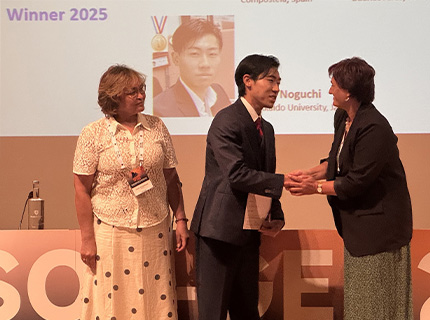
報告者は、博士論文「Construction of Photonic–Plasmonic Coupling Color Material Combining Structural Colors by Colloidal Particles and Localized Surface Plasmon Resonances by Metal Nitride Nanoparticles」[1]により、ISGSが優れた博士論文に授与するISGS PhD Thesis Award 2025(Gold Medal)を受賞した。本会議において表彰を受け(図1)、受賞対象となった博士論文の研究成果を中心に、高分子材料を利用した無機化合物の形態制御合成という観点も取り入れて、「Photonic–plasmonic coupling color materials based on SiO2–MN architectures via a liquid-phase process」と題して発表を行った。
■研究テーマ
液相プロセスによるSiO2-金属窒化物(MN)複合構造を基盤としたフォトニック-プラズモニック型発色材料
(ISGS PhD Thesis Award 2025の受賞対象となった博士論文の研究成果を中心とし、高分子材料を利用した無機化合物の形態制御合成の観点を取り入れた内容)
■研究背景
色材は、塗料、インク、化粧品、ディスプレイなど幅広い分野で欠かせない材料である。有機色素は鮮やかな色を示す一方、光や熱によって分解し退色するという課題がある。無機顔料は耐久性に優れるが、有害元素を含むものもある。これらに対し、微細な周期構造による光の干渉・回折によって発色する「構造色」は、色素を用いないため退色せず、有害元素も必要としない、環境負荷の小さい発色手法として注目されている。
しかし構造色には、見る角度によって色が変わる(角度依存性)という課題がある。短距離の秩序のみをもつ構造とすることで角度依存性は低減できるが、今度は不規則な散乱光が増えて色が白色に近づき、コントラストが低下する。報告者らは、特定の波長域のみを吸収する成分を組み込み、フォトニック特性とプラズモニック特性の両方を発現させる方法に着目した。そこで、金属的な電子構造をもち、可視~近赤外域に局在表面プラズモン共鳴(Localized surface plasmon resonance: LSPR)を示す窒化チタン(TiN)、窒化ジルコニウム(ZrN)、窒化ハフニウム(HfN)などの金属窒化物(MN)を取り上げ、そのLSPRを構造色材料の波長選択的な吸収に利用することを着想した。
■研究目的
本研究では、構造をつくるSiO2と、特定波長を吸収するMNナノ粒子を組み合わせた粒子を液相プロセスで作製し、その粒子積層膜において、フォトニック特性(構造色)とプラズモニック特性(LSPR吸収)の効果を評価することを目的とした。粒子の構造としては、①MNナノ粒子をSiO2殻で包んだMN–SiO2コア-シェル粒子と、②単分散SiO2粒子の表面にMNナノ粒子を付着させたSiO2–MNコア-サテライト粒子の2種類を検討した。
■方法と結果
(1)MN–SiO2コア-シェル粒子
合成した窒化ジルコニウム(ZrN)ナノ粒子をゾル-ゲル法でSiO2の殻に包み込み、ZrNを内包したコア-シェル粒子を作製した。反応時間によりシェルの厚みを制御した[2]。さらに、この手法を窒化チタン(TiN)や窒化ハフニウム(HfN)にも拡張し、乾燥させるとほぼ黒色になる金属窒化物ナノ粒子の粉体でも、SiO₂に埋め込むことでLSPRに由来する発色が得られることをHfNで実証した[3]。
(2)SiO2–MNコア-サテライト粒子
高分子材料でSiO2粒子の表面を修飾し、MNナノ粒子を表面に付着させる手法を開発した。この高分子による表面修飾が鍵となり、TiN、ZrN、HfNのいずれでも、SiO2粒子の周りをMNナノ粒子が取り囲んだ複合粒子が得られた。この粒子でつくった膜では、構造色の反射のうち、MNが吸収する波長の光だけが選択的に抑えられることを明らかにした。これにより、構造色(フォトニック効果)と金属窒化物のLSPR吸収(プラズモニック効果)を組み合わせた発色を実証した[4]。さらに、粒子の並びが適度に乱れることで、見る角度による色の変化が小さくなり、表現できる色の範囲はSiO2だけの場合の約5倍に広がった。SiO2の粒径、MNの種類、MNの付着量という3つの因子で光学特性を設計できる、貴金属を使わない新しい色材の設計指針を示すことができた[5]。
■討論内容
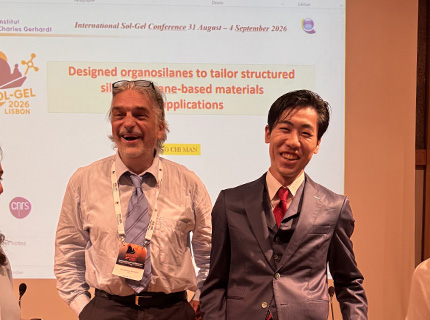
質疑応答では、Marco Faustini教授(Sorbonne University)から、MNナノ粒子の付着量の制御方法やSiO2表面への付着の安定性など、粒子の付着状態の制御について質問を受け、議論した。さらに、University of PadovaのAlessandro Martucci教授ともガスセンサー応用について議論し、共同研究の可能性についても意見を交わした(図2)。これらの議論を通じて、粒子の形態の制御性をさらに向上させるために、高分子材料の効果の解明とその利用方法が重要であることを再認識した。
■参考文献
[1] Shinji Noguchi, Ph.D. Dissertation, Hokkaido University, 2025.
[2] Shinji Noguchi et al., Journal of the American Ceramic Society, 107(10), 6885-6895, 2024.
[3] Shinji Noguchi et al., Nanoscale, 2026, DOI: 10.1039/d6nr02372j.
[4] Shinji Noguchi et al., Advanced Optical Materials, 12(19), 2400287, 2024.
[5] Shinji Noguchi et al., Advanced Optical Materials, e71880, 2026.
本会議における最大の成果は、ISGS PhD Thesis Award 2025(Gold Medal)の授賞式に出席して表彰を受けるとともに、その研究成果を、新たな観点も交えて発表できたことである。審査委員会からは、本論文について「ゾル-ゲル化学がナノスケールの材料合成と巨視的な光学機能とを橋渡しすることを示し、次世代の機能性光学材料に向けた汎用的な基盤を提供するもの」との評価を受けた。ゾル-ゲル分野で最も権威のある国際会議の場で表彰を受け、さらに世界各国の研究者を前に自らの研究成果を発表できたことは大きな励みとなった。また、受賞をきっかけに多くの研究者から声をかけられ、研究内容について議論する機会が大きく広がった。本賞の副賞として、Journal of Sol-Gel Science and Technologyへの総説論文投稿とISGS eSeminarでのオンライン講演の招待を受けており、今後これらを通じて研究成果をさらに国際的に発信していきたい。
本会議では、ゾル-ゲル法およびコロイド化学を基盤とする材料研究の最新動向に、まとまった形で触れることができた。特に、光学・フォトニクスや触媒応用のセッションでは、フォトニック特性を利用した分子センサーやプラズモニック特性を利用したガスセンサーに関する発表や光触媒材料に関する発表があり、自身の研究とは異なる手法や視点からの取り組みを知ることができた。中でもMarta Costa Lourenço氏(Instituto Superior Técnico)の発表は、液相合成を利用した無機材料の触媒開発という点で大きな示唆を与えるものであった。また、プレナリー講演では、David Kisailus教授(University of California, Irvine)による生物に学んだナノ構造ハイブリッド材料の合成や、Shu-Hong Yu教授(中国科学技術大学)によるナノからマクロまでの階層構造をもつ生体模倣材料に関する講演があり、構造を精密に制御して機能を引き出す材料設計の重要性を改めて感じた。
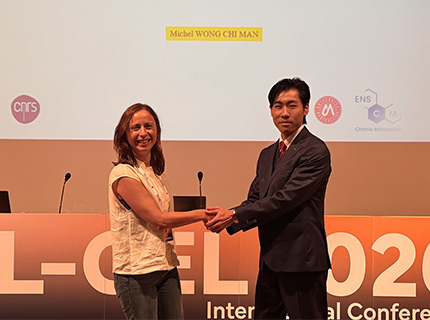
自身の発表では、英語での講演と質疑応答を通じて、研究の新規性と意義を海外の研究者に直接伝えることができた。発表後にはInstituto Superior TécnicoのAna Clara Marques 教授らと個別に議論する機会を得て、共同研究の可能性について意見を交わした(図3)。
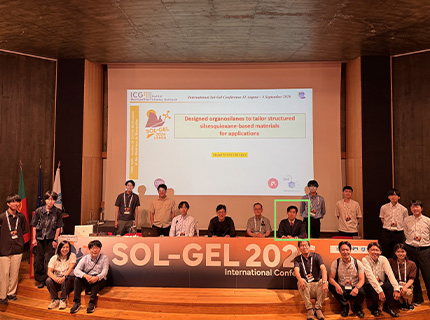
また、ポスター会場や休憩時間、バンケット等の交流行事においても、欧州をはじめ各国の研究者や若手研究者と交流し、それぞれの国の研究環境やキャリアについて情報交換を行った。ここで築いたつながりは、今後の共同研究や国際的な研究ネットワークの構築につながる貴重な財産である(図4)。
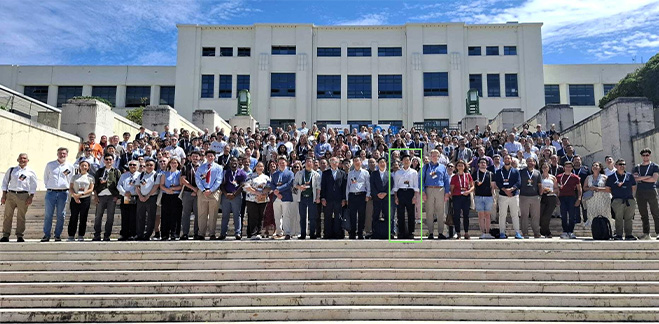
さらに、本会議は液相中で無機化合物を合成するという共通の手法を軸に、エネルギー、環境、医療など多様な応用分野の研究者が集まる場であったため(図5)、自身の専門である無機化合物の形態制御合成以外の発表からも、粒子の表面修飾や複合化、薄膜形成に関する技術的なヒントを多く得ることができた。分野の垣根を越えて議論できたことは、国内の学会ではなかなか得られない貴重な経験であった。今後は、本会議で得た知見と人とのつながりを研究に反映し、成果を国際誌や国際会議で積極的に発信していきたい。
最後に、本会議への参加にあたり多大なご支援を賜りました一般財団法人丸文財団に、心より御礼申し上げます。
English Version
The International Sol-Gel Conference is a biennial international conference organized by the International Sol-Gel Society (ISGS). It covers inorganic and organic–inorganic hybrid materials prepared by sol–gel processing and other soft-chemistry routes (low-temperature synthesis from the liquid phase), ranging from fundamentals such as precursor chemistry and reaction mechanisms, through the structural control of particles, thin films and porous materials, to applications and industrial use in optics, energy, the environment, medicine and electronics. Originating from an international workshop held in Padova, Italy, in 1981, it is regarded as one of the longest-standing and most prestigious conferences in this field, bringing together researchers in ceramic science, inorganic chemistry and materials engineering.
The 23rd conference (Sol-Gel 2026) was held over five days, from August 31 to September 4, 2026, at the IST Congress Centre on the Alameda campus of Instituto Superior Técnico (IST), University of Lisbon, in Lisbon, the capital of Portugal. The program covered topics including (1) the chemistry of sol–gel processes, (2) hybrid and composite materials, (3) the design of nanomaterials, (4) functional coatings and thin films, (5) optical, photonic and optoelectronic applications, and (6) catalysis and sensor applications, with plenary lectures, invited lectures, oral presentations and poster presentations held in parallel sessions. More than 300 participants from 39 countries attended, including researchers from universities and research institutes, industry representatives and early-career researchers. In addition to the ISGS award ceremonies, a banquet and other events offered many opportunities for participants to interact outside the scientific sessions.
I received the ISGS PhD Thesis Award 2025 (Gold Medal), which the ISGS presents for outstanding doctoral theses, for my doctoral thesis entitled “Construction of Photonic–Plasmonic Coupling Color Material Combining Structural Colors by Colloidal Particles and Localized Surface Plasmon Resonances by Metal Nitride Nanoparticles”[1]. I was honored at the conference (Figure 1) and gave a presentation entitled “Photonic–plasmonic coupling color materials based on SiO2–MN architectures via a liquid-phase process,” which centered on the results of the award-winning thesis while also incorporating the perspective of polymer-assisted, morphology-controlled synthesis of inorganic compounds.
■ Research Theme
Photonic–plasmonic color materials based on SiO2–metal nitride (MN) composite architectures prepared via a liquid-phase process
(Centered on the results of the doctoral thesis that received the ISGS PhD Thesis Award 2025, incorporating the perspective of polymer-assisted, morphology-controlled synthesis of inorganic compounds)
■ Background
Colorants are indispensable in a wide range of fields, including paints, inks, cosmetics and displays. Organic dyes provide vivid colors but decompose and fade under light and heat, while inorganic pigments are durable but some contain toxic elements. In contrast, structural color, which arises from the interference and diffraction of light by fine periodic structures, has attracted attention as an environmentally friendly coloring method: it uses no dyes, does not fade, and requires no toxic elements.
However, structural color suffers from angle dependence; that is, the color changes with the viewing angle. Structures with only short-range order can reduce this angle dependence, but they increase incoherent scattering, which makes the color closer to white and lowers the contrast. We focused on incorporating a component that absorbs only a specific wavelength range, so that both photonic and plasmonic properties are expressed. We therefore turned to metal nitrides (MN) such as titanium nitride (TiN), zirconium nitride (ZrN) and hafnium nitride (HfN), which have a metallic electronic structure and exhibit localized surface plasmon resonance (LSPR) in the visible to near-infrared range, and conceived the idea of using their LSPR for wavelength-selective absorption in structural color materials.
■ Objective
This study aimed to prepare, via a liquid-phase process, particles combining SiO2 as the structural component with MN nanoparticles as a wavelength-selective absorber, and to evaluate the photonic properties (structural color) and plasmonic properties (LSPR absorption) in their particle-stacked films. Two particle architectures were examined: (i) MN–SiO2 core–shell particles, in which MN nanoparticles are encapsulated in a SiO2 shell, and (ii) SiO2–MN core–satellite particles, in which MN nanoparticles are attached to the surface of monodisperse SiO2 particles.
■ Methods and Results
(1) MN–SiO2 core–shell particles
ZrN nanoparticles were encapsulated in a SiO2 shell by a sol–gel process to prepare core–shell particles containing ZrN, and the shell thickness was controlled by the reaction time[2]. We further extended this approach to titanium nitride (TiN) and hafnium nitride (HfN), and demonstrated for HfN that embedding the nanoparticles in SiO2 recovers LSPR-derived coloration in dried powders, which are otherwise nearly black[3].
(2) SiO2–MN core–satellite particles
We developed a method in which the surface of SiO2 particles is modified with a polymer so that MN nanoparticles attach to the surface. This polymer-mediated surface modification proved to be the key, and composite particles in which MN nanoparticles surround a SiO2 particle were obtained for all of TiN, ZrN and HfN. In films made of these particles, we showed that, within the structural-color reflection, only light at the wavelengths absorbed by MN is selectively suppressed. This demonstrated coloration that combines structural color (the photonic effect) with the LSPR absorption of metal nitrides (the plasmonic effect)[4]. Moreover, the moderately disordered arrangement of the particles reduced the change in color with the viewing angle, and the range of reproducible colors was expanded to about five times that of SiO2 alone. These results provide a design guideline for new noble-metal-free colorants whose optical properties can be designed through three factors: the SiO2 particle size, the MN species and the amount of attached MN[5].
■ Discussion
During the Q&A session, Prof. Marco Faustini (Sorbonne University) asked about controlling the attachment state of the particles, including how to control the amount of attached MN nanoparticles and the stability of their attachment to the SiO2 surface, and we discussed these points. I also discussed gas sensor applications with Prof. Alessandro Martucci of the University of Padova and exchanged views on potential collaboration (Figure 2). Through this discussion, I recognized anew the importance of clarifying the role of polymers and how best to use them in order to further improve the controllability of particle morphology.
■References
[1] Shinji Noguchi, Ph.D. Dissertation, Hokkaido University, 2025.
[2] Shinji Noguchi et al., Journal of the American Ceramic Society, 107(10), 6885-6895, 2024.
[3] Shinji Noguchi et al., Nanoscale, 2026, DOI: 10.1039/d6nr02372j.
[4] Shinji Noguchi et al., Advanced Optical Materials, 12(19), 2400287, 2024.
[5] Shinji Noguchi et al., Advanced Optical Materials, e71880, 2026.
The greatest outcome of this conference was attending the award ceremony of the ISGS PhD Thesis Award 2025 (Gold Medal) to receive the award, and presenting my research results with new perspectives. The award committee commented that “the thesis demonstrates how sol–gel chemistry bridges nanoscale materials synthesis and macroscopic optical functionality, providing a versatile platform for next-generation functional optical materials.” Being honored at the most prestigious international conference in the sol–gel field, and presenting my own research to researchers from around the world, was a great encouragement. The award also prompted many researchers to approach me, greatly expanding my opportunities to discuss my research. As part of the award, I have been invited to contribute a review article to the Journal of Sol-Gel Science and Technology and to give an online lecture in the ISGS eSeminar series, and I intend to use these opportunities to further disseminate my research internationally.
The conference provided a comprehensive view of the latest trends in materials research based on sol–gel and colloid chemistry. In particular, the sessions on optics/photonics and catalysis included presentations on molecular sensors using photonic properties, gas sensors using plasmonic properties, and photocatalytic materials, which introduced me to approaches and perspectives different from my own. Among them, the presentation by Marta Costa Lourenço (Instituto Superior Técnico) offered valuable insights into the development of inorganic catalysts by liquid-phase synthesis. In the plenary lectures, Prof. David Kisailus (University of California, Irvine) spoke on the synthesis of nanostructured hybrid materials inspired by biology, and Prof. Shu-Hong Yu (University of Science and Technology of China) on bio-inspired materials with hierarchical structures spanning the nano- to macroscale. These lectures reminded me of the importance of materials design that precisely controls structure to bring out functionality.
Through my presentation and the Q&A in English, I was able to convey the novelty and significance of my research directly to researchers from other countries. After the presentation, I had the opportunity for individual discussions with Prof. Ana Clara Marques of Instituto Superior Técnico and her colleagues, and we exchanged views on the possibility of collaborative research (Figure 3).
At the poster sessions, during breaks and at social events such as the banquet, I interacted with researchers and early-career scientists from Europe and other regions, exchanging information about research environments and careers in their countries. The connections made here are a valuable asset that will lead to future collaborations and to building an international research network (Figure 4).
Furthermore, because the conference brought together researchers from diverse application fields such as energy, the environment and medicine (Figure 5) around the common approach of synthesizing inorganic compounds in the liquid phase, I gained many technical hints on particle surface modification, composite formation and thin-film fabrication, even from presentations outside my own specialty of morphology-controlled synthesis of inorganic compounds. Discussing across disciplinary boundaries was a valuable experience that is rarely available at domestic conferences. Going forward, I will apply the knowledge and connections gained at this conference to my research and actively disseminate the results in international journals and at international conferences.
Finally, I would like to express my sincere gratitude to the Marubun Research Promotion Foundation for its generous support of my participation in this conference.

